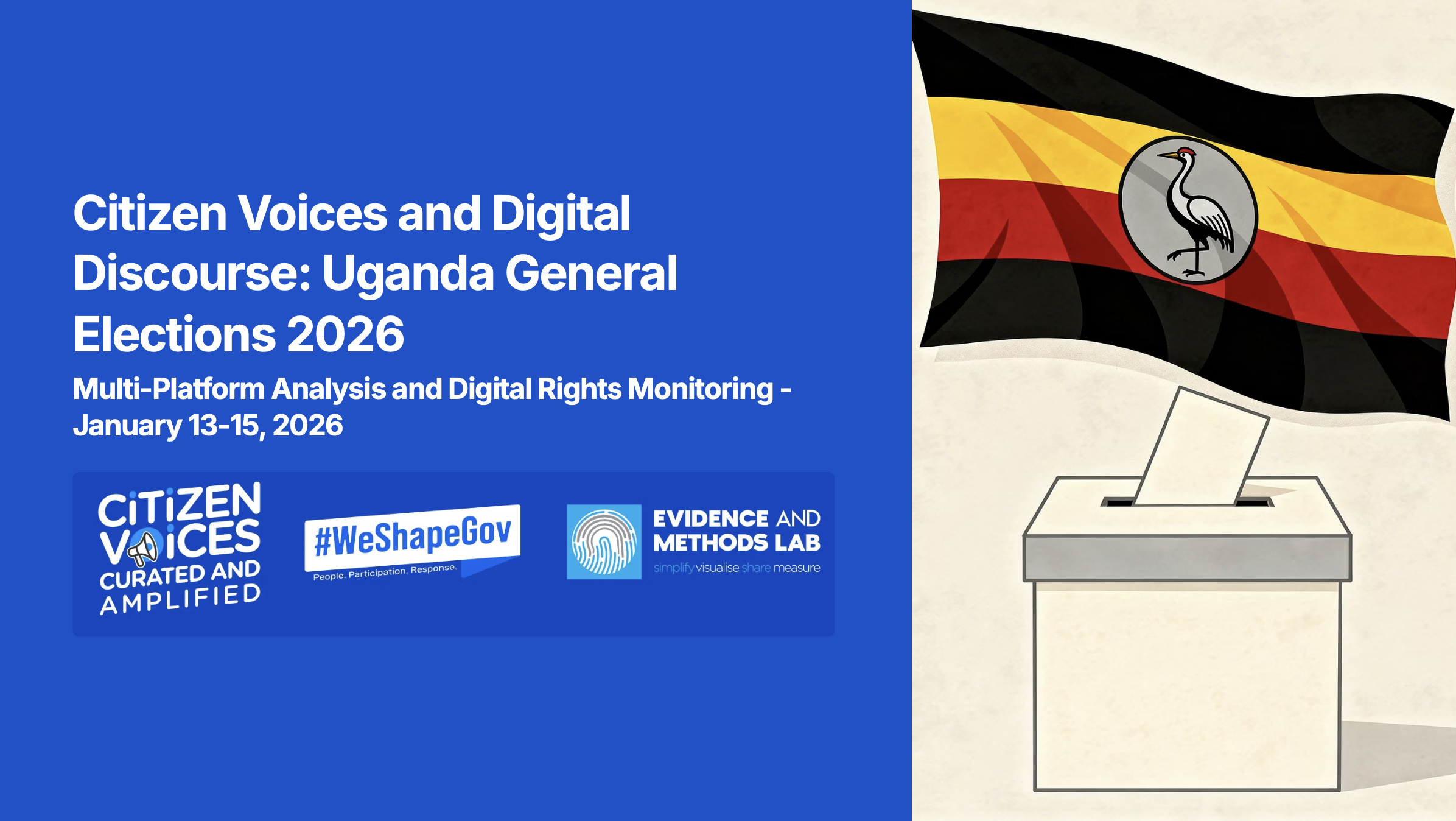
By Evidence And Methods Lab | January 15, 2026
Between January 13-15, 2026, as Ugandans went to the polls, two stories unfolded simultaneously. While official narratives spoke of a seamless electoral process, a starkly different reality emerged from digital platforms—one of citizen voices struggling to be heard amid internet shutdowns and systematic suppression.
To capture this unfolding story, we conducted a comprehensive multi-platform analysis during the critical 72-hour period. Our team monitored and analyzed approximately 150+ posts and content pieces across X (Twitter), TikTok, Facebook, WhatsApp, and news media channels. Using hashtag-based monitoring (#UgandaDecides2026, #UGDecides2026, #DemocracyOnTrial, #SpotlightonUgElections2026 etc), we documented citizen experiences, concerns, and real-time observations as they emerged—before the digital blackout silenced these voices completely.
This analysis represents only the content that successfully reached platforms despite internet restrictions. The actual volume of attempted citizen communication was likely far higher, suppressed by the progressive shutdown that began on the evening of January 13 and reached full effect by election day afternoon. What we captured provides a crucial window into the lived experiences of Ugandans navigating democracy under digital suppression—a reality that challenges official accounts and reveals the growing tension between digital engagement and state control in the modern electoral process.
The Digital Blackout: When Connectivity Becomes a Political Tool
On election day, a chilling pattern of digital suppression unfolded across Uganda, effectively silencing citizens at democracy's most critical juncture. Social media platforms, the very arteries of real-time communication and collective action, became inaccessible. VPNs, often a lifeline for those seeking to bypass state-imposed restrictions, were systematically throttled, grinding connections to a halt. The digital public square, so vital for civic engagement, went dark. The internet shutdown commenced on the evening of January 13, 2026, intensifying throughout January 14 and reaching full effect on election day, January 15.
The impact was immediate and profound, creating a vacuum of information and accountability. Citizens, bearing witness to the democratic process, found themselves unable to share real-time observations from polling stations. This meant that electoral irregularities, which might otherwise have been swiftly documented and exposed, vanished into the digital void as they happened. For example, at St. Denis Sebugwawo Church in Makindye West, polling materials hadn't arrived by 8:00 a.m. with no explanation—incidents like this went largely undocumented in real-time. Biometric Voter Verification Kit (BVVK) failures at multiple polling stations couldn't be widely reported. Similarly, arrests of opposition leaders, including NUP Deputy President for Western Uganda Jackline Jolly Tukamushaba, were documented by the few who maintained connectivity. International observers, stripped of this crucial citizen-generated data, lost a vital window into the ground realities of the election, severely hindering their ability to assess the fairness and transparency of the process. Digital mobilization efforts, carefully constructed to inform and engage the electorate, were utterly neutralized. As one frustrated citizen succinctly put it, capturing the anguish of many: "They shut us down when we need to speak the most."
Despite severe restrictions, some Ugandans demonstrated remarkable ingenuity. Diaspora networks played crucial roles as vital conduits for amplifying voices from inside Uganda. The limited number of individuals who successfully circumvented restrictions using VPNs emerged as critical witnesses to the electoral process. This marked the second consecutive election cycle marred by major internet restrictions, following the 2021 Facebook ban that regrettably remains in effect.
This was no mere technical glitch or unfortunate coincidence. This digital blackout represented a deliberate and strategic suppression of citizen voices, precisely timed to coincide with a critical democratic exercise. It laid bare a calculated attempt to control the narrative and impede transparency, transforming connectivity itself into a potent political tool.
The Crackdown Before the Blackout
The widespread digital suppression observed on election day in Uganda was not an abrupt measure, but rather the culmination of a systematic crackdown that had been intensifying for several weeks prior to the polls. In the critical pre-election period, the focus of authorities began to shift aggressively towards social media critics and content creators. These individuals, often vocal about political issues, increasingly found themselves targeted for their online activism.
Notable cases from November 2024 through January 2026 illustrate the systematic nature of this crackdown. Emmanuel Nabugodi, just 21 years old, was sentenced to 2 years and 8 months in prison for posting a video of a mock trial of President Museveni—prosecuted under the Computer Misuse (Amendment) Act, 2022 for 'ridiculing' and 'spreading hate speech.' In November 2024, three TikTokers were arrested and charged with 'hate speech' and 'spreading malicious information' for videos deemed insulting to the President, First Lady, and officials. David Ssengozi and Isaiah were arrested in 2025 for critical political commentary on TikTok, part of a broader pattern targeting youth digital activists.
The Computer Misuse (Amendment) Act, 2022—specifically Section 26—makes it an offense to share information through a computer that is likely to 'ridicule, degrade, or demean another person' or 'spread hate speech or malicious information.' This vague language has been weaponized to criminalize legitimate political criticism and satire.
Pre-election survey data revealed that 67% of respondents feared violence at polling stations. The pre-election crackdown on digital expression added another layer of fear—not just physical violence, but legal persecution for online political participation.
This escalating intervention manifested in clear patterns: prominent TikTok creators were arrested, accused of "spreading misinformation," and social media influencers who had dared to voice criticism against the government faced intimidation tactics. These actions were designed to send a strong message, fostering a profound chilling effect on the digital political discourse.
Consequently, widespread self-censorship became prevalent among content creators, who understood the severe repercussions that awaited them for expressing dissenting views. As one analyst acutely observed, this pre-election environment cultivated a pervasive sense of "digital fear." Citizens were forced to grapple with a difficult choice: weighing the inherent risks of speaking out against their fundamental democratic imperative to participate in public dialogue. The message from the authorities was unequivocal: digital dissent would simply not be tolerated without significant consequences, setting the stage for the complete blackout that followed on election day.
What Citizens Were Saying: Key Themes from the Ground
Despite pervasive suppression tactics, citizen voices found ways to emerge. Four consistent themes dominated the discourse:
Electoral Irregularities: "My Name is Not on the Register"
A primary concern revolved around widespread electoral irregularities. Citizens meticulously documented instances of delayed voting materials, noted missing names on voter registers at polling stations, and reported suspicious patterns that cast a shadow over the integrity of the process. This sentiment was encapsulated by the frequently echoed and deeply frustrating lament: "My name is not on the register, yet I voted here in 2021." Specific examples included reports of polling materials not arriving by 8:00 a.m. at locations like St. Denis Sebugwawo Church in Makindye West, and widespread failures of Biometric Voter Verification Kits (BVVKs) at multiple stations. Indeed, thousands of posts on platforms like X (formerly Twitter) using hashtags such as #UgandaDecides2026 amplified these concerns, showing a determined effort to hold the system accountable.
Youth Mobilization: Digital Activism in Action
Amidst these significant challenges, young Ugandans—representing 78% of the population under 30—demonstrated remarkable adaptability and resilience. They leveraged digital platforms not merely for casual engagement but for an unprecedented level of political mobilization. Hashtags like #myvotemychoice, memes, and viral content became tools not only to rally voters but also to disseminate critical information when traditional media channels were either compromised or constrained. For instance, viral TikTok content dissecting candidate promises or exposing local issues reached hundreds of thousands before crackdowns. Furthermore, youth at polling stations like Kibuye were observed using tape measures to mark the 20-meter observation distance, showcasing their active participation and understanding of electoral rules.
Digital Resilience: Adapting to Suppression
When mainstream platforms were eventually shut down, citizens quickly adapted. They employed virtual private networks (VPNs) to circumvent blockades, shifted to encrypted messaging applications like Signal and Telegram, and established alternative digital spaces to continue documenting their experiences and maintaining vital communication networks. WhatsApp groups, in particular, transformed into primary channels for real-time updates and community organizing during these shutdowns, demonstrating remarkable adaptability and an unwavering commitment to communication.
Frustration with the Process: Democracy on Trial
Beyond the technical glitches and logistical hurdles, a profound frustration with the overall electoral process permeated citizen discourse. Many expressed deep disillusionment with what they perceived as a fundamentally compromised electoral framework, openly questioning the legitimacy of results announced against a backdrop of widespread connectivity blackouts. The #DemocracyOnTrial hashtag emerged to frame these irregularities within broader democratic concerns, with citizens echoing sentiments like "Patterns matter more than excuses" and observing that "This reveals a democracy where participation is counted, but influence is constrained." This collective sentiment underscored a growing skepticism about the fairness and transparency of the entire democratic exercise, revealing a citizenry grappling with the difficult reality of a system they felt had failed them.
What This Means for Democracy
The Uganda 2026 elections lay bare a profound tension at the heart of modern democracy: the exhilarating promise of expansive digital participation clashes violently with the grim reality of pervasive digital control. When access to the internet, a seemingly neutral utility, is weaponized as a political instrument, the very foundations upon which democratic governance rests are not merely shaken, but fundamentally compromised.
This deliberate suppression of digital avenues carries grave implications, striking at the core of electoral integrity and the fundamental rights of citizens. Transparency in elections hinges significantly on real-time documentation by citizens – their photos, videos, and firsthand accounts serving as an indispensable accountability mechanism. Yet, the strategic deployment of internet shutdowns effectively dismantles this crucial safeguard, creating an environment where irregularities can proliferate unchallenged. More than a convenience, digital access has evolved into a fundamental right, essential for meaningful democratic engagement. Consequently, these systematic shutdowns are not just technical disruptions; they represent a severe violation of citizens' inherent ability to observe, document, and actively participate in the processes that determine their leadership.
The repercussions of such actions extend far beyond national borders, posing significant challenges for the international community. Traditional election observation methods, while valuable, are increasingly insufficient in an era where much of political life and information exchange now unfolds within the digital realm. The deliberate silencing of digital voices, therefore, must be regarded with the same gravity as physical voter intimidation. The pattern so starkly observed in Uganda – characterized by pre-election crackdowns, election-day blackouts, and calculated post-election information control – unfortunately establishes a dangerous playbook for digital authoritarianism. This insidious strategy presents a significant and escalating threat, imperiling democratic processes not just across the African continent but globally.
Moving Forward: Protecting Digital Democracy
Immediate Actions Needed
Addressing the immediate fallout of digital suppression during elections requires a multi-pronged approach. This includes exerting concerted international pressure against election-period internet shutdowns, unequivocally signaling that such tactics are unacceptable. Concurrently, robust legal frameworks are critically needed to protect digital rights throughout electoral processes. Supporting digital rights organizations and citizen journalists is paramount, as they serve as the frontline in documenting abuses and ensuring accountability. Furthermore, investing in circumvention technologies and fostering digital resilience can empower citizens to bypass state-imposed restrictions and maintain access to vital information.
Long-term Solutions
Establishing long-term safeguards is essential for cultivating genuine digital democracy. This involves implementing constitutional protections that enshrine internet access as a fundamental democratic right, ensuring it cannot be arbitrarily denied. Independent oversight bodies are crucial for monitoring telecommunications during elections, preventing politically motivated interference and ensuring a level playing field. Moreover, building capacity for citizen documentation and promoting widespread digital literacy can empower individuals to engage effectively and safely online, while regional standards against digital suppression can create a unified front to deter future abuses.
The voices captured in this analysis—frustrated, resilient, and determined—represent a generation unwilling to accept digital authoritarianism as the price of participation. Their experiences must inform how we collectively protect democratic spaces in the digital age, transforming these urgent needs into actionable and lasting solutions.
Download the Full Report
This article summarizes key findings from our comprehensive 72-hour multi-platform analysis. The full report includes detailed methodology, complete quantitative analysis, in-depth citizen testimonies, temporal analysis, comparative survey data, platform-specific findings, and comprehensive recommendations.
Download: Citizen Voices and Digital Discourse - Uganda General Elections 2026
About the Evidence and Methods Lab
The Evidence and Methods Lab is a civil society organization focused on citizen empowerment and governance improvement across Africa. Our approach utilizes data, evidence, and digital tools to:
· Support citizen participation in democratic processes
· Enhance the delivery of essential public services
· Promote accountable and inclusive governance
For additional information on our initiatives and inquiries, please visit our website at www.evidenceandmethodslab.org.