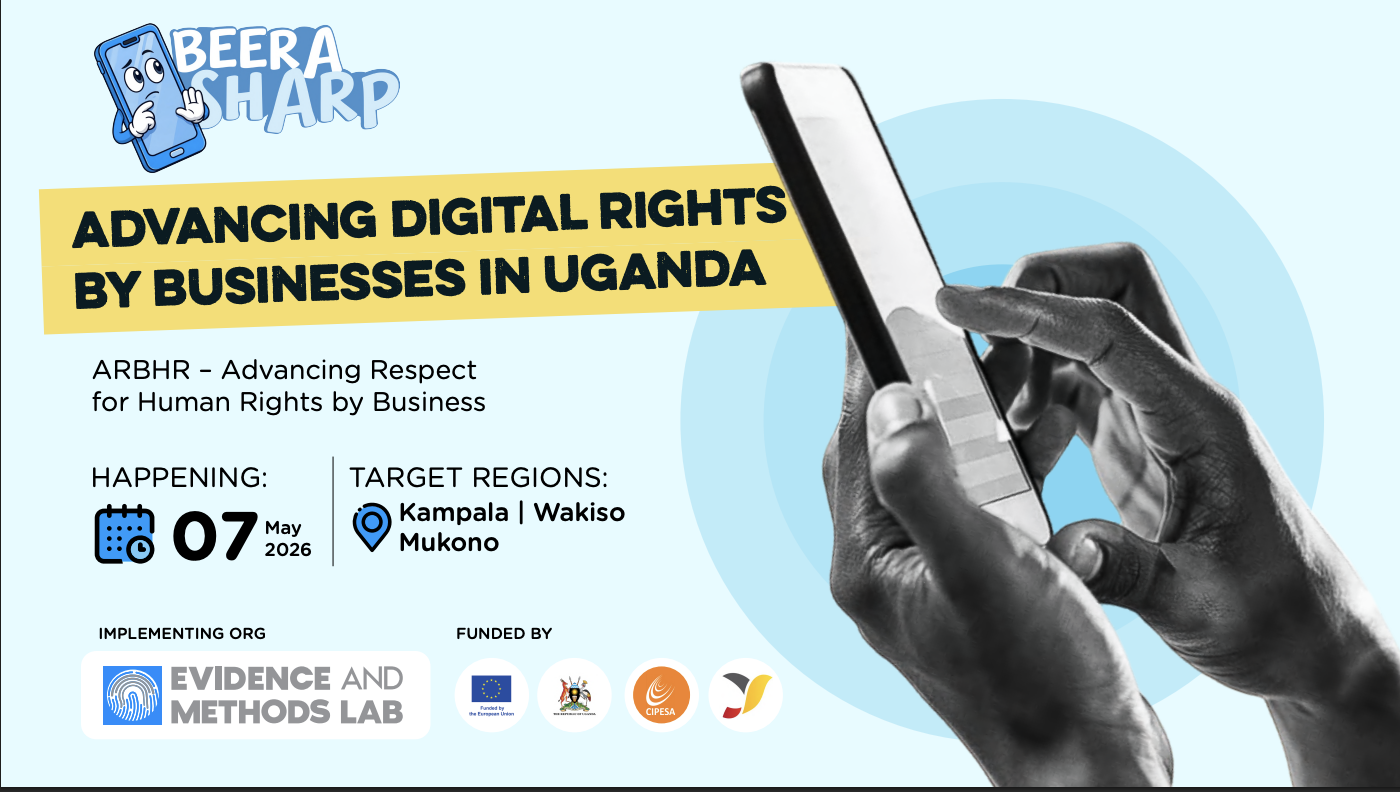
On 7th May 2026, we sat in a room with our partners for a High-Level Stakeholder Dialogue on Advancing Digital Rights by Businesses in Uganda. It was one of those meetings where you step back and look at everything that has been built — and you realize how much ground has been covered.
We want to tell that story properly.
Uganda's digital economy is growing, but not evenly. Mobile penetration is at 88 percent nationally, yet internet access in rural areas sits at just 22 percent. Seventy-one percent of rural women have never used the internet. For small business owners navigating mobile money, digital payments, and online platforms every day, the risks are not abstract. Fraud, phishing, data misuse, these are things happening to real businesses right now.
That is the problem the Advancing Respect for Human Rights by Business (ARBHR) project was designed to address. Working in the areas of Kampala, Wakiso, and Mukono, we launched a national awareness campaign that combined a TEDx-style digital rights talk, influencer campaigns, social media content, exhibition booths at the State of the Digital Economy (SODE) conference and DevFest Kampala, and a breakfast television segment on NBS through our partnership with NEXT Media.

Over 2.3 million people reached with 1.7 million of those through television at the State of Digital Economy. The campaign ran under the hashtag #BeeraSharp — "be sharp" in Luganda.
On 4th December 2025, we hosted 105 small and medium enterprise owners on a one-hour Zoom webinar. Two expert-led sessions, one on cybersecurity, one on digital rights and followed by open conversation. Business owners are not confused about whether digital threats are real. They know they are real. What they wanted was very specific: what do I do when I get a suspicious mobile money message? How do I know if a link is safe?
We developed the Beera Sharp chatbot and deployed it on WhatsApp because that is where Ugandan businesses already are. It is multilingual, available at any hour, and gives plain-language answers to digital rights questions in real time. What is a digital footprint? What are my rights if my data is misused? How do I recognise a phishing attempt?
We produced a one-minute animated video, re-voiced and adapted for Uganda in English and local languages. It ran on social media, Facebook, Instagram, X and on digital billboard screens across Kampala. The goal was to bring digital rights awareness into the spaces where people already spend their time, without asking them to seek it out.
A few things became very clear by the end of Phase I.
Broadcast partnerships change the scale of what is possible. Our work with NEXT Media extended our reach in ways we could not have achieved alone.
Local language is not optional. Content in Luganda and Runyakitara landed differently with audiences. When the message sounds like it comes from your world, you listen differently.
Practical beats polished. Business owners responded to real scenarios, the kind of fraud that happens to someone like them, far more than they responded to technically accurate but abstract messaging. If the content does not connect to a recognizable situation, it does not stick.
And people want tools alongside the information. There is plenty of information about digital rights. What is not enough of is clear, simple, usable guidance for someone running a small business with no dedicated technology team. That gap is exactly where the chatbot, the videos, and the podcasts we are building in Phase II are designed to sit.
We are already into it. The Beera Sharp chatbot is being expanded to Telegram and web platforms, with a stronger knowledge base, an analytics dashboard, and tighter security and data governance.

We are producing six infographic series and four animated videos on Uganda's Data Privacy and Protection Act for digital distribution and community spaces such as markets and public institutions. And we are recording 10 podcast episodes on digital rights and cybersecurity, featuring experts, policymakers, and practitioners, with a target audience of over 30,000 listeners.